Boston Children’s heart specialists are always looking to help children and young adults recover quickly. The partial heart transplant is our latest step toward that goal. It can reduce the need for future surgeries by giving patients a healthy replacement heart valve that naturally grows with them. Our specialists are among the few in the world to offer the procedure.
What is a partial heart transplant?
For most patients with valve disease, our heart specialists always try to repair the valve as the first treatment option. But for valves that cannot be repaired, or for patients who have had a previous valve replacement, the partial heart transplant is a new option to replace the valve. A partial heart transplant removes a heart valve that has been affected by heart disease and replaces it with a healthy one from a donor. The procedure is similar to a heart transplant except it involves only the diseased valve. Cardiac surgeons perform the procedure, while cardiologists oversee a child’s care before and after. After surgery, a child needs to take immunosuppressive medication to prevent their immune system from rejecting the new valve.
How does the procedure decrease the need for future surgeries?
If your child has a partial heart transplant, they will benefit from having living human valve tissue implanted into their heart. Living tissue is expected to grow along with the rest of their heart, and it is resistant to clotting and damage that can occur with artificial valves. Although this is a new procedure, we expect that the transplanted valve will function well for a decade or even much longer, minimizing the number of future replacement procedures. In order to prevent rejection of the valve, immunosuppression is necessary, although in the future we hope it may be possible to even reduce or eliminate its use.

Jack had a first-of-its-kind surgery with the aim of making it his last
Learn how Jack made Boston Children’s cardiac surgery history as New England’s first partial heart transplant patient
Which heart conditions are treated with a partial heart transplant?
How do I know if my child is a candidate for a partial heart transplant?
If your child needs replacement of a heart valve, our specialists can evaluate if they are a candidate for a partial heart transplant. We will contact your family to discuss the procedure, the process of being on a transplant waiting list, and what you can expect after the procedure, including recovery and the management of your child’s immunosuppression.
Other replacement valve options can also fit a child’s needs
Partial heart transplant is one of many options available to treat valve conditions. The treatment is always personalized to each patient’s lifestyle and valve anatomy. Our Congenital Heart Valve Program can help you find the best choice for your child. Those options include:
- Valve repair: More than 90 percent of valves can be repaired using the body’s own valve tissue. We always prefer to repair valves, even if previous attempts at repair have been unsuccessful. We take advantage of state-of-the-art 3D modeling from the Cardiovascular 3D Modeling and Simulation Program, as well as advanced repair techniques and technology developed at Boston Children’s. We always prefer repair over replacement if possible.
- Bioprosthetic valve replacement: Bioprosthetic tissue (from a pig or cow) replaces the valve. It can last 10 to 15 years, sometimes longer. There are several types of valves, some of which were developed by Boston Children’s.
- Mechanical valve replacement: Mechanical valves are made of strong, durable materials like metal or carbon. They don’t wear out easily and can last a long time. They do require patients to take blood thinners for life.
- The Ross procedure: This procedure treats aortic valve disease. A child’s own pulmonary valve replaces their aortic valve, so their tissue will grow naturally in a new position. A donor valve goes where the pulmonary valve was; it may need to be eventually replaced.
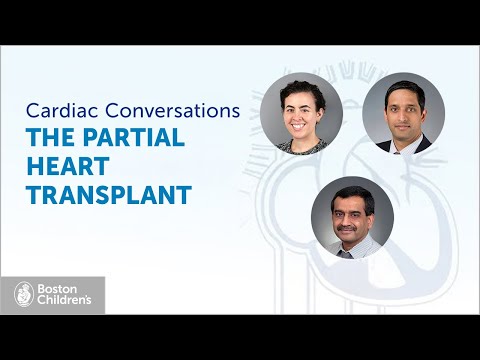
Cardiac Conversations: The partial heart transplant
Watch our heart specialists discuss how a partial heart transplant works and how it benefits children.