Contact Us
Contact the Hand and Orthopedic Upper Extremity Program
617-355-6021
International
+1-617-355-5209


A broken arm is a crack or break in one or more of the bones in arm. Broken arms, also known as arm fractures, are often caused by an impact injury, such as from a fall or collision.
A simple arm fracture is usually treated with a splint or cast, however, a complex fracture may require surgery. With proper treatment, broken arms can heal completely. Children typically regain full use of their arm within a couple weeks after their final cast is removed.
Learn more about different types of fractures in children.
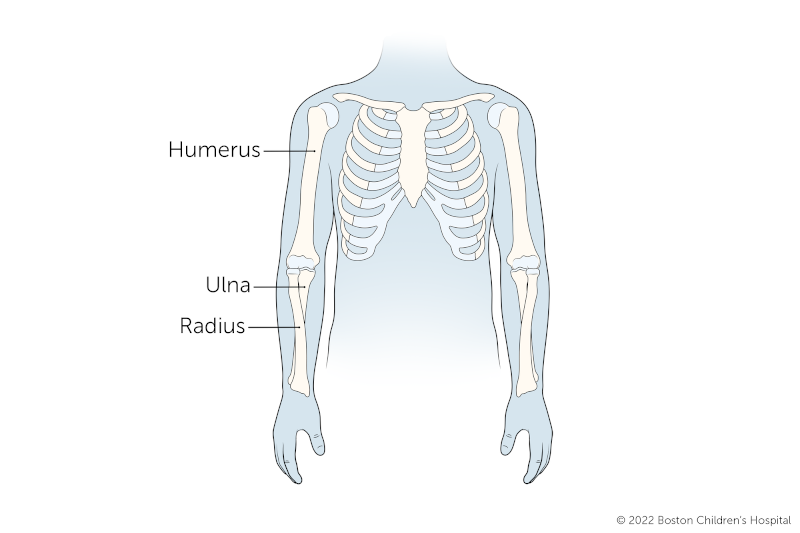
There are three main bones in the arm:
Childhood broken arms can be caused by:
Common signs of a broken arm include:
The doctor will carefully examine your child’s arm looking for symptoms of a fracture. The doctor may also order one or more of the following imaging tests to help them see signs of a broken bone as well as damage to nearby muscles or blood vessels:
Treatment for a broken arm depends on the specific location and severity of the break, your child's age, overall health, and medical history.
Splints and casts immobilize injured bones to promote healing and reduce pain and swelling. They are sometimes put on after surgical procedures to ensure that the bone is protected and in the proper alignment as it heals.
Splints are used for minor breaks. Splints support the broken bone on one side and immobilize the arm to promote bone alignment during healing. Splints are often used in emergency situations to hold a joint in a steady position while a child is transported to a medical facility.
Casts are stronger than splints and provide more protection to the injured area. They hold a broken bone in place while it heals by immobilizing the area above and below the joint.
Some common types of casts for broken arms include:
Traction corrects broken or dislocated bones by using a gentle and steady pulling motion to stretch muscles and tendons in a specific direction around the broken bone. This allows the bone ends to align and heal, and in some cases, it reduces painful muscle spasms.
Closed reduction is a nonsurgical procedure used to reduce and set the fracture. Using an anesthetic (typically given through an IV in the arm), the doctor realigns the bone fragments from outside the body and holds it in place with a cast or splint.
Surgery may be needed to put broken bones back into place. A surgeon may insert metal rods or pins located inside the bone (internal fixation) or outside the body (external fixation) to hold bone fragments in place to allow alignment and healing. This is done under general anesthesia.