Meet James
James’ parents call him a “warrior” for getting to the other side of treatment for a serious heart condition. Read about the 6-month-old’s journey to good health and how he’s always smiling.


Tetralogy of Fallot (TOF) is a serious congenital heart defect affecting about two in 10,000 babies. In TOF, a set of four abnormalities in the heart’s anatomy prevent enough oxygen-poor (blue) blood from flowing to the lungs to receive oxygen. As a result, people with TOF have a lower than normal amount of oxygen in their blood and will typically need surgery to correct the flow. Infants born with TOF were once called “blue babies.”
In a normal heart, oxygen-poor blood from the body returns to the right atrium and travels to the right ventricle. Then, it is pumped through the pulmonary artery into the lungs, where it receives oxygen. That oxygen-rich (red) blood returns to the left atrium from the lungs, passes into the left ventricle, and then is pumped through the aorta out to the body.
Children born with TOF have a combination of four changes in their heart anatomy that limit blood flow to their lungs:
The restricted blood flow to the lungs caused by TOF normally worsens with time. Sometimes, the pulmonary valve, providing one-way blood flow between the right ventricle and the lungs, is completely obstructed. This is a more severe form of TOF called tetralogy of Fallot with pulmonary atresia.
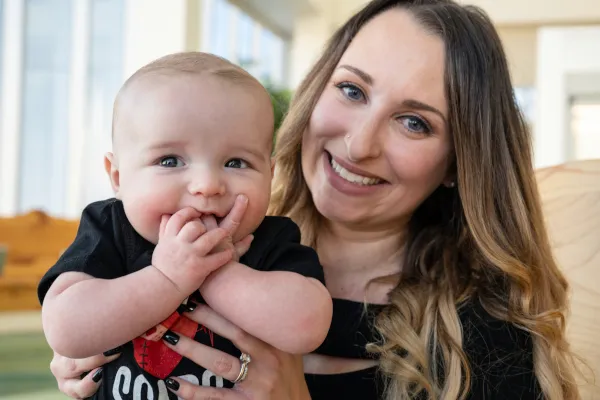
James’ parents call him a “warrior” for getting to the other side of treatment for a serious heart condition. Read about the 6-month-old’s journey to good health and how he’s always smiling.
Cyanosis, a blue color of the skin, is often the first sign of tetralogy of Fallot. The skin turns blue when the amount of oxygen in the blood is lower than normal. In some children, a particular kind of heart murmur is the first sign of TOF.
Even after a baby is diagnosed with TOF, there may be no symptoms for weeks or even months. Sometimes the blood flow to the lungs is not very restricted. In those cases, babies may be pink but show signs of “failure to thrive” — essentially, they breathe rapidly, get tired from feeding, and can’t gain weight. Typically, these newborns start with mild symptoms that worsen over time. In other cases, the narrowing to the lungs is quite significant, and in those cases the babies may remain blue but not have the same rapid breathing.
Tet spells, also known as hypercyanotic episodes, are a more severe symptom of TOF. These sudden spells can occur after feeding, bathing, or crying. They are caused by a further decrease in blood flow to the lungs, making the baby more blue, and sometimes irritable and short of breath. Fortunately, tet spells don’t occur too frequently because we are able to diagnose and treat TOF early.
Most cases of TOF have no genetic association. However, there are some cases with a genetic link. Parents who already have a child with a congenital heart defect are slightly more likely to have a second child with a heart defect. Boston Children’s Hospital maintains a Tetralogy of Fallot Genetics Registry that is exploring possible causative genes.
Tetralogy of Fallot can be detected during an ultrasound exam during pregnancy. If your clinical team suspects your baby may have TOF, they will order a fetal echocardiogram (cardiac ultrasound) to further evaluate the structure of the heart and how it's functioning with this condition.
Once your baby is born, a pediatric cardiologist will listen to your baby’s heart and lungs, feel the baby’s pulses, measure the oxygen level in the blood through pulse oximetry (a non-invasive test), and use other several tests to help clarify the diagnosis, including:
Almost all children with tetralogy of Fallot will need surgery. Many children can be treated medically until a complete repair can be done. More severe forms of TOF may require early intervention, including hospitalization.
Most babies with TOF do not need heart catheterization, but sometimes this procedure can provide the care team with further information. In severe circumstances, some children need to have a stent placed via a catheter to open the heart’s connection to the lung artery.
Children with TOF typically undergo surgery between 3 and 6 months of age. For most, a full repair surgery is performed as one operation. But in rare instances, a child may require a series of operations. Then, an initial operation will place a Blalock-Taussig-Thomas (BTT) shunt, a tube connecting the lung artery with an artery near the heart, to increase blood flow to the lungs. This operation keeps the baby’s condition stable until further repairs can be done. However, at Boston Children’s Hospital we can also pursue, depending on your child’s condition, cutting-edge options in addition to a traditional BTT shunt.
Full surgical repair of TOF consists of:
If your child also has pulmonary atresia, surgeons will also reconnect the heart’s right ventricle to the pulmonary (lung) artery by placing a new valve or connecting tube. If your child has major aortopulmonary collateral arteries (MAPCAs), they may need multiple procedures.
Children with tetralogy of Fallot may need additional operations or catheterizations as they grow older. Although the goal of the initial operation is to provide the best long-term flow to the lungs, some children develop leakage from the lung valve, requiring replacement in the future. This often occurs in adolescence or early adulthood, although it can happen sooner.
Teenagers with congenital heart defects stay with their cardiologist until adulthood for medical appointments and procedures. Sometimes children need to limit physical activities, but there is still a lot that they can do. As adults, they will need to be followed by a congenital cardiologist because complications can arise in adulthood. TOF patients may be at some risk for arrhythmias (abnormal heart rhythms), leaky valves, and other heart problems.
Non-cardiac surgeries may pose risks for people with tetralogy of Fallot and will require evaluation and discussion with a cardiologist. For women with TOF, pregnancy may also present risks; our Boston Adult Congenital Heart (BACH) and Pulmonary Hypertension Program has a team of doctors dedicated to this evaluation.
Our team in the Boston Children’s Benderson Family Heart Center treats some of the most complex pediatric heart conditions in the world, with excellent results. Adults who were treated for congenital heart disease as children will need to be followed by a cardiologist because complications from early heart disease can arise in adulthood. The Boston Adult Congenital Heart Program (BACH) is a world leader in the care of this unique patient population.
