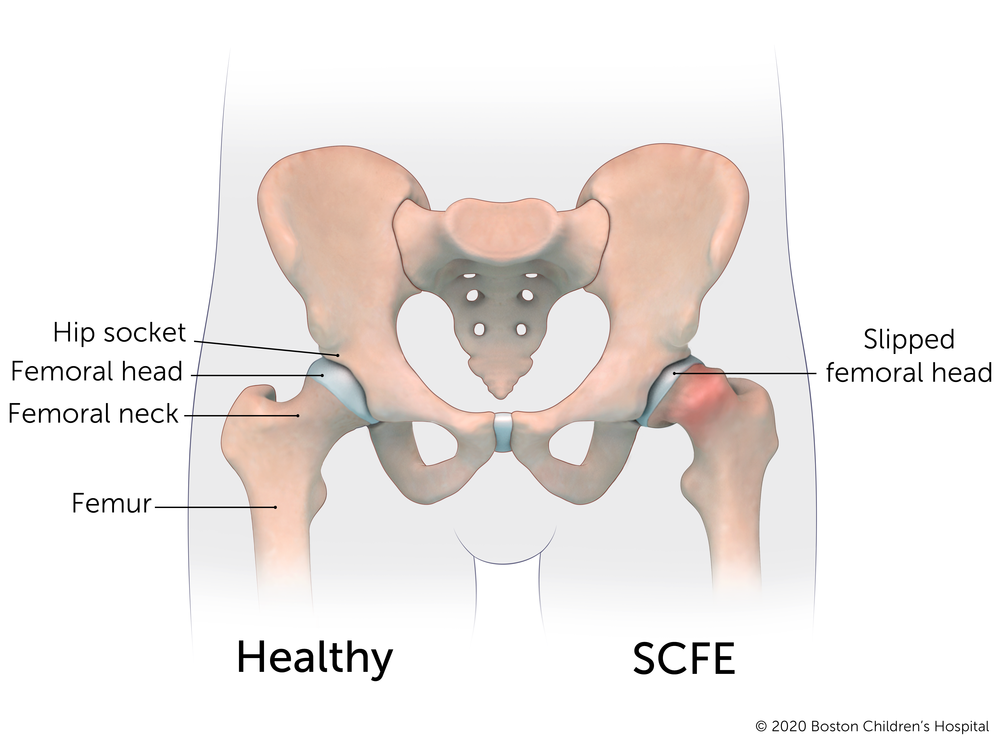
In pre-adolescent and adolescent growth and development, a child is growing quickly as adult hormones begin to circulate in his or her system. The growth plate (the area at the end of bone responsible for growth, which is not as strong as bone) gets weaker because it’s broadening. These phenomena, combined with certain anatomical factors, such as the shapes of the femur and the socket, can lead to slippage.
Slipped capital femoral epiphysis (SCFE) is a rare condition that is slightly more likely to occur in boys than girls. SCFE occurs in about one per 1,000 to one per 10,000 children and teens; children ages 12 to 14 years are most at risk. SCFE is more prevalent in the northeast region of the U.S. than in the southwest and is more prevalent among African-Americans.
Risk factors that increase the likelihood of SCFE include:
SCFE is usually an emergency and must be diagnosed and treated early. In 20 to 40 percent of affected children, SCFE will be present in both hips at the time the child is diagnosed. If only one hip is affected, the other hip will eventually slip 30 to 60 percent of the time. Treatment is surgical.