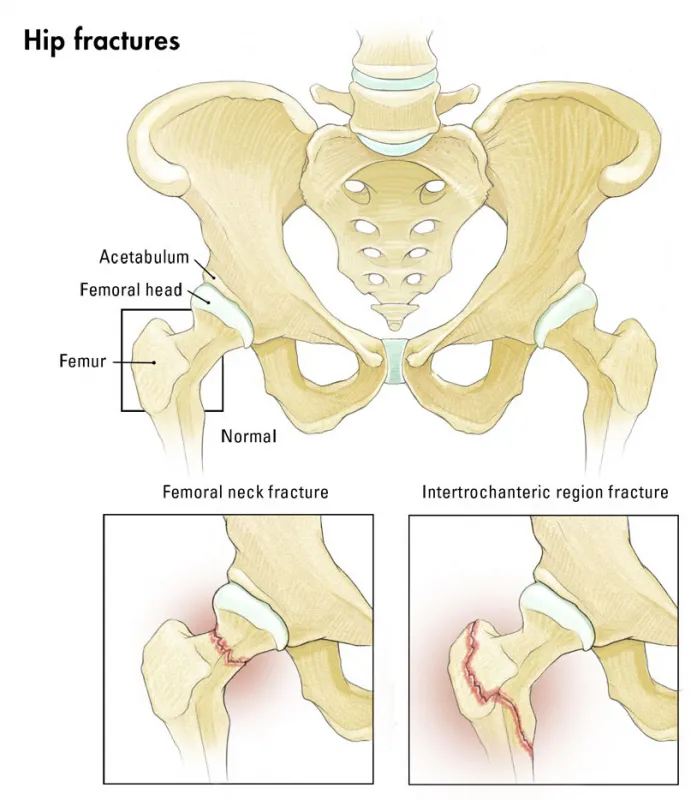
Fractures happen when there’s more force applied to the bone than the bone can absorb. If your child has a fracture, it means that his bone has partially or completely broken. A hip fracture should be treated quickly and correctly — the hip is the body’s connection to the legs and is crucial for movement.

A hip fracture is a partial or complete break in any of the three bones of the pelvis that make up the hip: the illium (upper part), the ischium (lower part), or the central pubis that joins the ischium on either side. Fractures can also occur where the thigh bone (femur) angles into the hip socket (proximal femur fracture), or in the socket (acetabulum) where the thigh bone rotates. Hip fractures are common in the elderly and rare in children because a child's bones are designed to absorb more force.
The hip joint is one of the body's most reliable structures, providing movement and support without pain or problems in most people for a lifetime. The hip's simple ball-and-socket arrangement — with the ball-shaped head of the thigh bone rotating inside a cup-shaped socket called the acetabulum — usually works well with amazingly little friction and little or no wear.
The well-fitting surfaces of the head of the thigh bone and the acetabulum, which face each other, are lined with a layer of cartilage, lubricated by a thin film of fluid. Friction inside a normal hip is less than one-10th that of ice gliding on ice.

Common signs and symptoms of a broken hip can include:
A risk for developing a fracture increases if he has:
Hip fractures in teens are commonly due to sports injuries. When a hip is fractured, other structures housed by the pelvic bones can get injured, too. These can include:
Note: Boston Children’s Skeletal Health Center provides comprehensive evaluations of children and adolescents who have, or are at risk for, low bone density.
If your child is diagnosed with a broken hip, you may feel a bit overwhelmed. It can be easy to lose track of the questions that occur to you. Lots of parents find it helpful to jot down questions as they arise — that way, when you talk to your child’s doctors, you can be sure that all your concerns are addressed. If your child is older, he may want to ask questions, too.
Some of the questions you may want to ask include:
If you’re teen with a broken hip, you have a lot to cope with. Besides the typical issues any teenager faces — from social acceptance to body changes and more — you’ll also have to deal with medical appointments and procedures, finding alternative ways to get around, keeping your cast or sling safe, clean and dry, and limiting your activities for a period of time.
If you’re usually active, to be experiencing pain or sitting on the sidelines for a while can be depressing and frustrating. If you feel down, angry or anxious through this important time in your life, speak to your doctor, parent or counselor to get help—they’re all on your team, and they want to help. And remember that Boston Children’s Orthopedics and Sports Medicine Department is always here for you, too.
It’s hard to prevent a child from breaking a bone — especially if your child is very active and plays sports. But the value of kids’ participation in sports and play greatly outweighs the risk of breaking a bone.
While you can’t prevent your child from breaking a bone, you can help him minimize his risk with simple, common-sense steps:
Make sure he has plenty of calcium in his diet (milk, yogurt, cheese, fish, and leafy green vegetables are high-calcium foods)
Discourage prolonged time watching TV, playing computer games or other sedentary activities.
At Boston Children’s Hospital, we know that the first step in treating your child’s broken hip is to form an accurate and complete diagnosis.
During a physical exam, the doctor obtains a complete medical history of your child and asks how your child got hurt. The physician will look for any injuries commonly associated with hip fractures. These can include injury to any of the structures housed by the pelvic bones, such as the lower portion of the intestines and rectum, the urinary bladder, and the reproductive organs. Other commonly associated injuries include head injuries and additional fractures.
The doctor will examine any lacerations to determine whether an open fracture (bone visible through the skin) has occurred, and will press on front and back of the pelvic area to help determine how stable the hip is. A rectal examination also may be performed to look for hemorrhage that may signify bone penetration into the rectum.
A hip fracture should be treated quickly and correctly — the hip is the body’s connection to the legs and is crucial for movement.
If you think your child has broken his hip, you should take him to the Emergency Room. If you’re waiting to see your child’s doctor, it may help to use self-care first aid remedies to reduce swelling and pain:
Boston Children’s Hospital’s hip sub-specialists provide comprehensive treatment — including evaluation, diagnosis, consultation, and follow-up care — to their young patients. How we’ll treat your child’s hip fracture depends on the location, complexity, and severity of his break — as well as his age and overall health. Boston Children’s orthopedic experts in the Child and Young Adult Hip Preservation Program will provide comprehensive treatment — including evaluation, diagnosis, consultation, and follow-up care.
The overwhelming majority of children treated for a broken hip at Boston Children’s have corrections that enable their bones to grow normally — so they can walk, play, grow, and live active lives. Kids’ bones heal quickly, and usually without complications.
Our treatment goals are to:
To restore your child’s use of his broken hip bone, his doctor may recommend some combination of these possible treatments:
When a hip is fractured, other structures housed by the pelvic bones can get injured, too. These can include the lower portion of the intestines and rectum, the urinary bladder, and the reproductive organs. Other commonly associated injuries include head injuries and additional fractures.
Most non-surgical and surgical corrections of childhood fractures occur without complications. Although complications are relatively uncommon, they can occur and can include:
Our research into bone problems means that we can provide your child with the most innovative care available. As a result, the overwhelming majority of children treated for hip fractures at Boston Children’s have corrections that enable their bones to grow normally — so they can walk, play, grow, and live active lives.
A hip fracture is a serious injury, and it usually means that your child will need surgery. There may be exceptions, but as a general guideline, the younger the child, the quicker he’ll heal.
If your child or teen is being treated for a hip fracture, the best thing you can do for him is to keep and model a positive attitude. Make a game out of keeping your small child’s cast dry during bathing. Start a countdown calendar for your teen to help him see progress toward getting back to normal — and toward getting back into his game if he plays sports.
Still, we understand that a hospital visit can be difficult. So, we offer many amenities to make your child’s — and your own — hospital experience as pleasant as possible. Visit the Hale Family Center for Families for all you need to know about:
In particular, we understand that you may have a lot of questions when your child is diagnosed with a hip fracture. Will my child need surgery? How long will his recovery take? Will it affect my child long term? What should we do at home? We can help you connect with extensive resources to help you and your family through this stressful time, including: