Popular Search Terms


What is the spine?
The spine is made up of many individual bones called vertebrae joined together by muscles and ligaments. Flat, soft discs separate and cushion the vertebrae from rubbing against each other. Because the vertebrae are separate, the spine is flexible and can bend. Together the vertebrae, discs, muscles, and ligaments make up the vertebral column or spine. Some degree of front-to-back spinal curvature is healthy and supports everyday movement.
What are spine problems?
Some spine problems develop when normal spinal curves grow too large, or the spine curves in the wrong way. Other spine problems occur when the vertebrae are not strong enough to support the spine. Still others are caused by injuries that compromise the structure of the spine.
Spine anatomy
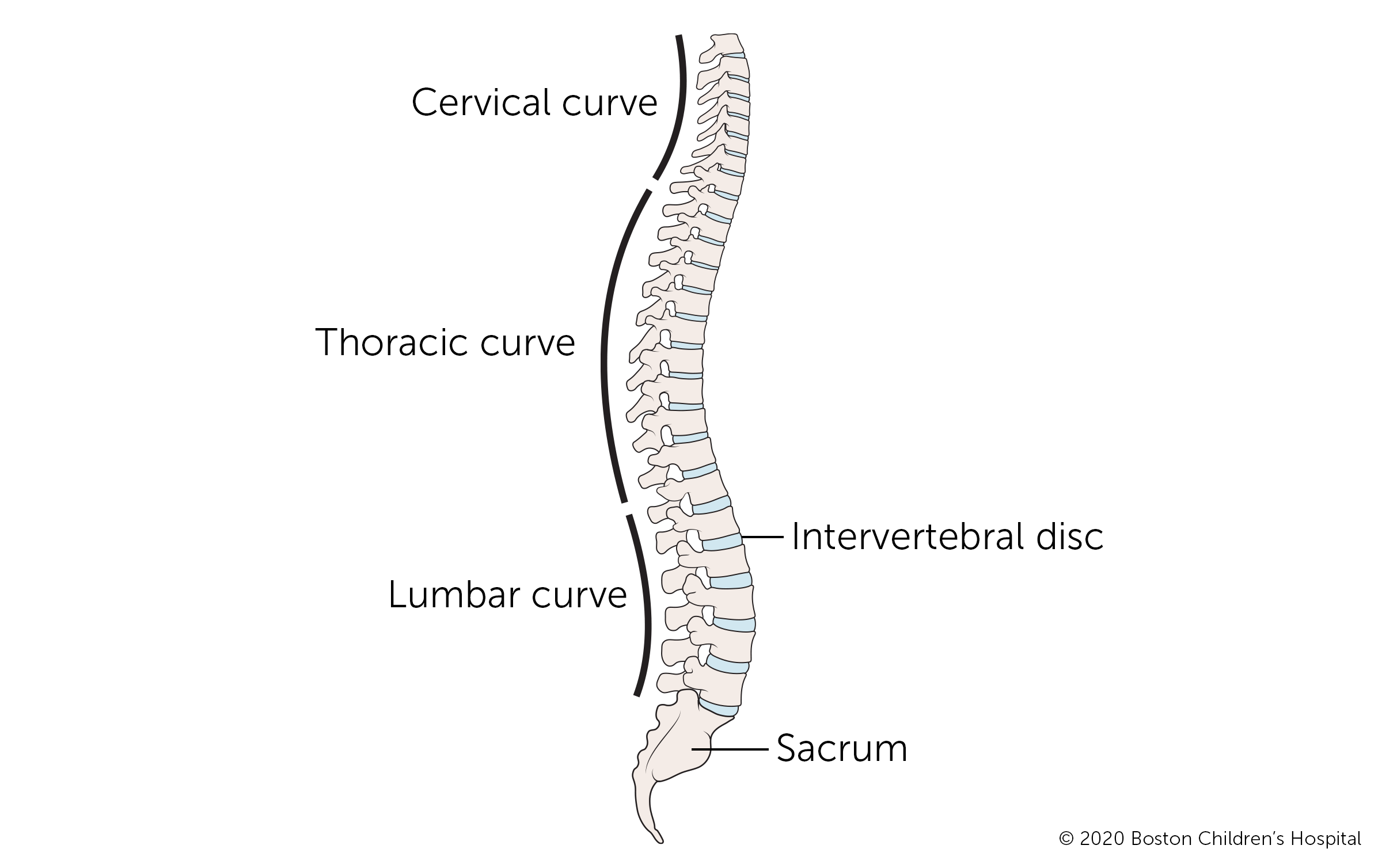
The sections of the spine have specific names.
- The cervical spine refers to the neck.
- The thoracic spine refers to the chest.
- The lumbar spine and sacral spine refer to the lower back.
What are normal spinal curves?
A normal spine is strong and mobile. While spines vary in size and shape from person to person, a healthy spine has natural front-to-back curves that make it possible to walk, balance, sit, stand, and twist, all of which are complex, interactive movements.
Children’s spines naturally curve in stages:
- During fetal development, the primary curves in the thoracic spine develop, as well as the sacral curve at the bottom of the spine.
- As babies, children have a C-shaped spine. Secondary curves in the cervical and lumbar spine develop as infants become able to lift their heads, sit up, crawl, stand, and walk.
- As children grow, their spine continues to develop natural curves into a normal, mature spine.
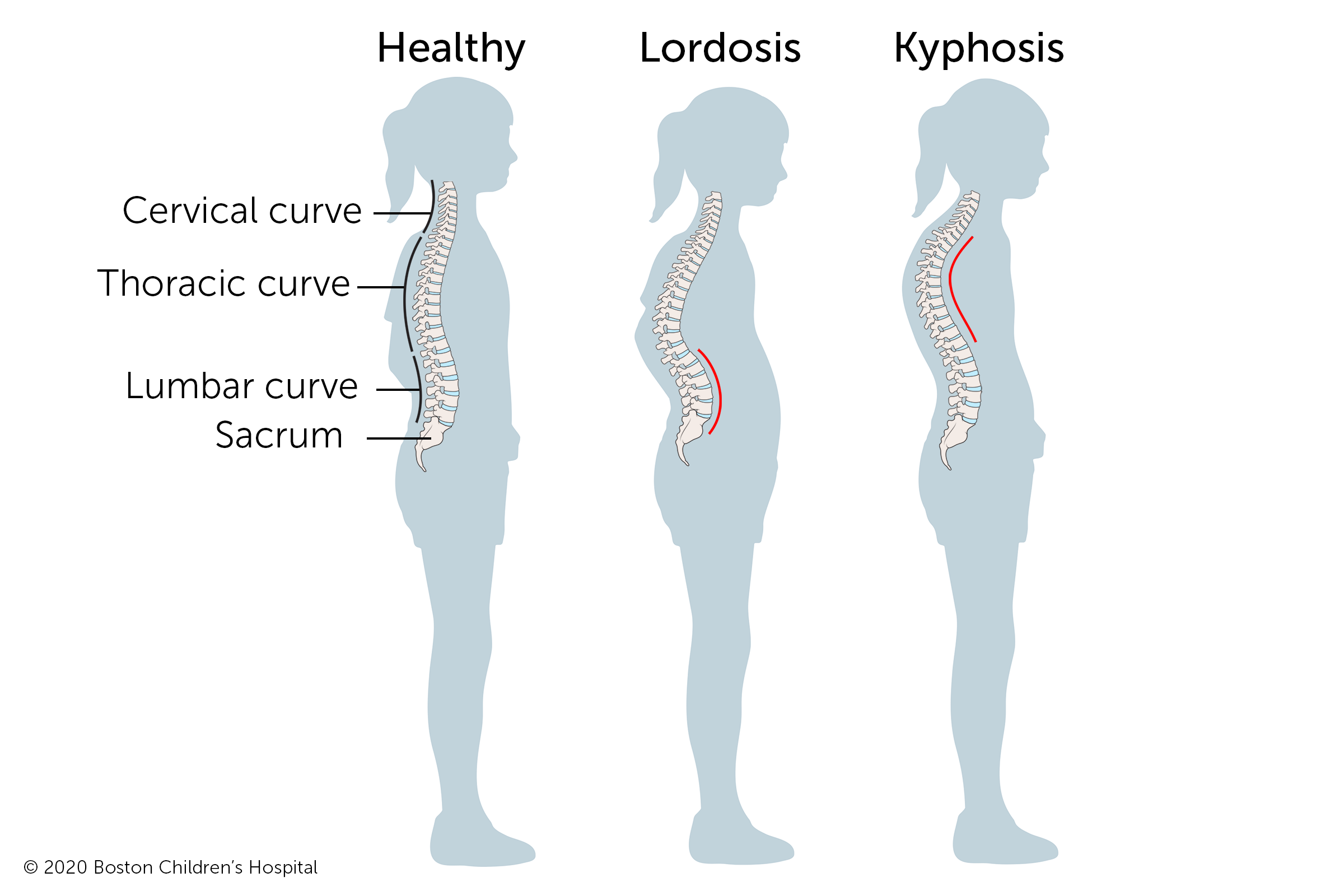
- Kyphosis, also known as thoracic hyper-kyphosis or “round back," is a backward curve in the thoracic spine that has become too extreme.
- Hypo-kyphosis describes when there's not enough backward curve in the thoracic spine.
- Thoracic lordosis describes a condition of the spine in which the natural outward curve of the thoracic spine is reversed, curving into the chest.
- Hyper-lordosis, also known as "swayback," occurs when the inward curve in the lower back is too great.
A side-to-side curve is called scoliosis. The curve may take the shape of an “S” (double curve) or a long “C” (single curve). A spine with scoliosis is also rotated or twisted, pulling the ribs along with it to form a multidimensional curve.
Who’s at risk for spine problems?
Risk factors for developing a spine problem vary from condition to condition. Common risk factors and predispositions for spine conditions include:
- A family history of scoliosis
- Other birth defects
- Neuromuscular conditions
- Metabolic conditions that affect the bones
- Syndromes that affect neurologic function
- Other genetic syndromes
When should you seek medical advice for a spine problem?
Several spine problems can be seen at or shortly after birth. Sometimes, spine problems are detected before birth using a prenatal ultrasound. Others, such as idiopathic scoliosis, will usually develop as the child grows, most often during the child’s adolescent growth spurt. Congenital scoliosis is present at birth, but may not be apparent until later.
Consult your pediatrician if your family has a history of spinal problems, or if your child is:
- Developing side-to-side curvatures
- Developing asymmetry in their shoulders or waist
- Developing a round upper back
- Experiencing unusual back pain
Symptoms & Causes
What causes spine problems?
Spine problems can be:
- Congenital (present at birth)
- Neuromuscular (associated with a neuromuscular condition such as cerebral palsy or spina bifida)
- Idiopathic (definite cause unknown)
- The result of bone dysplasia (genetically abnormal bone growth)
- Related to metabolic conditions (internal body chemistry)
- Related to connective tissue disorders such as Ehlers-Danlos syndrome
- Related to differences in leg lengths
- Related to spinal cord injury with paralysis
- Related to infections such as osteomyelitis
- Related to bone tumors
Diagnosis & Treatments
How are spine problems diagnosed?
Most spinal problems are detected by a child’s parents or pediatrician or during a school screening. Once a spine problem is detected, doctors will use medical and family histories, physical exams, and diagnostic tests to determine the nature and extent of your child’s spinal condition. Testing can include:
- X-rays
- Computerized tomography scan (CT or CAT scan)
- Magnetic resonance imaging (MRI)
- Blood tests
- Ultrasound (sonogram)
- Bone scans
- Bone density scans (dual-energy X-ray absorptiometry, DEXA, DXA)
- Pulmonary function tests
How are spine problems treated?
Treatment of spine conditions depends on the type, complexity, and severity of the condition. Some spine problems require surgery, while others can be resolved with non-surgical treatments.
Non-surgical options for spine problems
- Simple observation and monitoring: Once an abnormal spinal curve has been detected, it's important to monitor the curve during skeletal growth. Your child's spinal condition may need only close monitoring as your child grows. Your physician will determine your child's treatment plan and follow-up based on their X-rays and physical exams.
- Physical therapy: Some spinal problems are helped by physical therapy. The primary goal of physical therapy is to maximize a child’s physical functioning. Physical therapists work closely with spine specialists to provide exercise programs and other therapies to address the pain and muscular imbalance associated with a spinal abnormality.
What is the long-term outlook for children with spine problems?
The long-term outlook depends greatly on the nature and severity of the spinal condition, as well as the nature and severity of any underlying conditions. Most children with spine problems achieve full, normal function, normal appearance, and good general health.
How we care for spine problems
The Spine Division at Boston Children’s Hospital is the largest and busiest pediatric spine center in the United States. Our spine specialists see thousands of patients and perform hundreds of surgeries each year. We collaborate regularly with the Department of Neurosurgery to provide safe, customized care for even the most complex spine problems. For children with an injury or deformity of the neck or upper spine, Boston Children’s also offers the Complex Cervical Spine Program. Our Spine and Sports Program treats spine conditions and injuries that affect the young athlete.
