

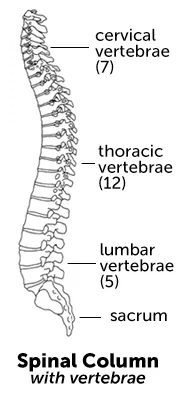
To understand how and why spinal cord injuries have different effects on different parts of the body, it’s helpful to understand the anatomy of the surrounding area. The spinal cord is divided into sections that correspond with the neighboring bones of the spine:
- Cervical (neck area)
- Thoracic (mid-back)
- Lumbar (lower back)
- Sacrum (base of the spine)
Typically, the higher the location of the injury, the more significant the resulting damage. Serious SCIs are categorized as either paraplegic — resulting in a loss of sensation and function in the lower half of the body — or quadriplegic/tetraplegic, resulting in a loss of feeling and movement from the chest down, including both arms and both legs.
Educational illustration of the spine in profile with labels for cervical (7), thoracic (12), and lumbar (5) vertebrae, plus the sacrum; titled “Spinal Column with vertebrae.”
