
Contact Us
Complex Cervical Spine Program
There is a recall of ibuprofen. Learn more >>


Klippel-Feil syndrome is a spinal deformity characterized by a short neck, low hairline, and limited neck mobility. The condition was named for two physicians, Maurice Klippel and Andre Feil, who first identified this trio of symptoms in a patient in 1912. Currently, the term Klippel-Feil syndrome is often used more broadly to describe any congenital (present at birth) fusions of the vertebrae in the cervical spine (neck).
True Klippel-Feil syndrome is rare, with only about 1 out of every 40,000 children born with the condition. However, congenital fusions of the spine are much more common.
The spine is made up of individual bones called vertebrae that protect the spinal cord, a dense bundle of nerves that carries signals to and from your brain and the rest of your body. Because the vertebrae are separate, the spine is flexible and can bend. In children born with Klippel-Feil syndrome, two or more of the vertebrae in the neck are fused. Vertebrae in the mid and lower back may also be fused.
The severity of the condition ranges from mild to serious, depending on which vertebrae are fused, how many, and whether the spinal cord or surrounding nerves are affected. Children with fusions at the top of the neck, and those with a higher number of fused vertebrae, tend to have more symptoms and become symptomatic at an earlier age.
Klippel-Feil syndrome is often accompanied by other conditions, such as hearing loss, vision problems, cleft palate, kidney problems, heart problems, or lung problems. Children with Klippel-Feil syndrome may also have other orthopedic issues, such as scoliosis, limb-length discrepancy, basilar invagination (the top of the spine presses into the base of the skull), or Sprengel deformity (underdeveloped shoulder blades with one significantly higher than the other).
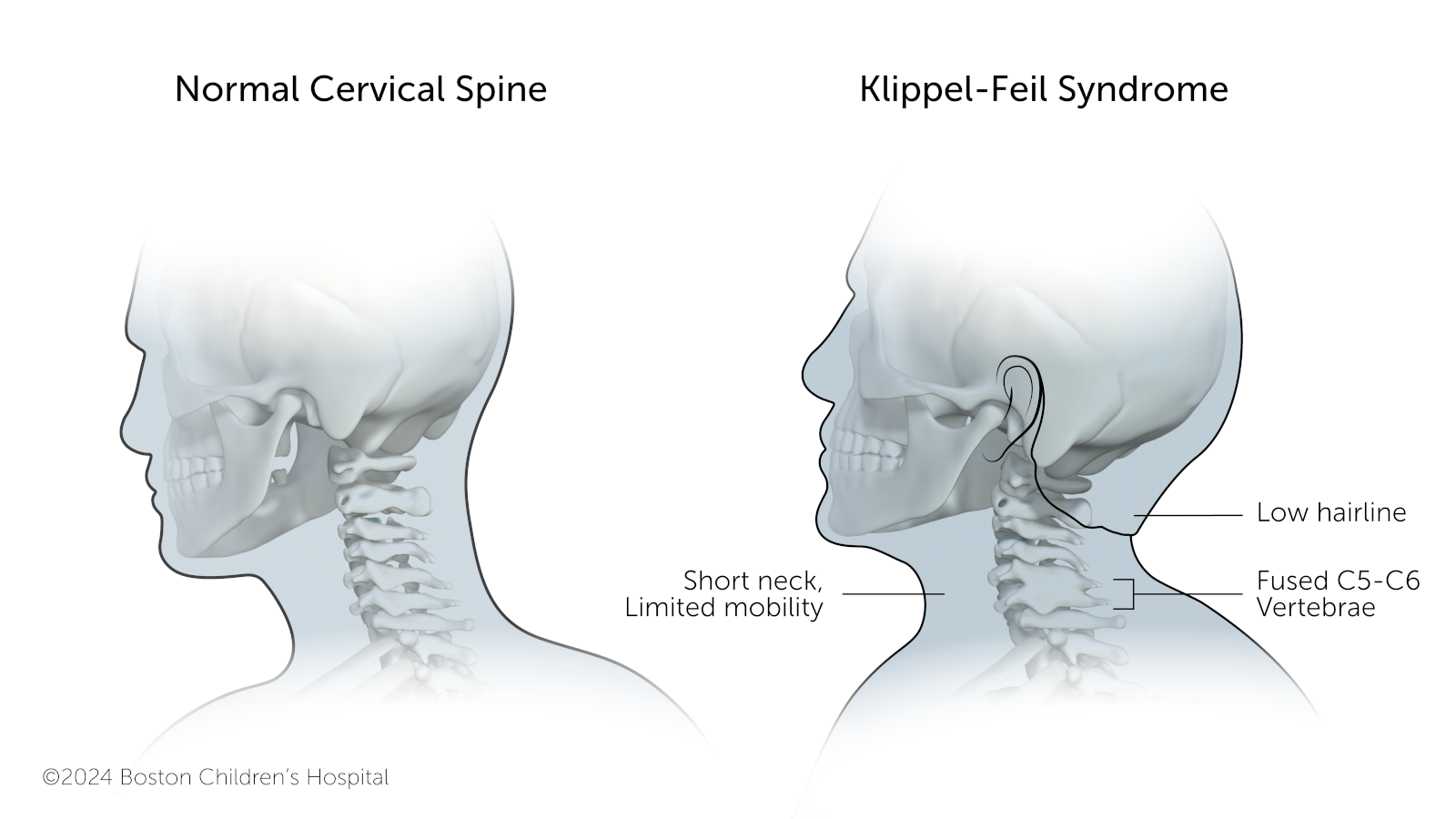
About half of children with Klippel-Feil syndrome do not have symptoms. In its more severe forms, Klippel-Feil syndrome can limit a child’s range of motion and cause chronic headaches and upper body and neck pain.
Symptoms can include:
Klippel-Feil syndrome is caused by a genetic mutation that seems to happen randomly. Most children with Klippel-Feil syndrome do not inherit the condition from a parent.
Doctors may diagnose severe forms of Klippel-Feil syndrome soon after a child is born. To make a diagnosis, doctors look for signs such as:
Your child’s doctor may order an X-ray to see which vertebrae are fused and look for signs of related conditions like basilar invagination or spinal stenosis. They may order an MRI to look for signs that the spinal cord or nerves are compressed.
Other tests can help diagnose related conditions, such as tests of heart function or kidney function. Genetic testing can be used to reveal more information about the mutation that caused your child’s condition.
Your child’s care team should include specialists who can address the specific ways your child is affected by Klippel-Feil syndrome. In addition to an orthopedic surgeon and neurosurgeon, this may include specialists in heart issues, lung issues, hearing loss, eye conditions, and kidney problems.
Many children with Klippel-Feil syndrome do not need surgery. Depending on your child’s symptoms, their treatment may include:
If your child’s cervical spine is unstable, or if they have nerve damage, they may need surgery to stabilize the spine and decompress the affected nerves.
Many children with Klippel-Feil syndrome live active, independent lives, and many participate in sports. If the vertebrae in your child’s neck are fused, they should avoid sports that put them at risk of falls or collisions. Your child’s doctor can tell you which sports are safe for your child based on which vertebrae are affected.
As they get older, some people who have had cervical spinal fusion develop osteoarthritis in the neck and upper back, spinal stenosis (narrowing of the canal that protects the spinal cord), or disk degeneration. It is therefore important to have regular follow-up care so your child’s care team can monitor their health and address any issues that arise.
The Complex Cervical Spine Program at Boston Children’s Hospital treats infants, children, and young adults with Klippel-Feil syndrome and other rare cervical spine abnormalities. As the first and largest multidisciplinary program of its kind in the country, we combine expertise in neurology, neurosurgery, and orthopedic surgery to deliver the safest patient care and the best outcomes.
The Pediatric Rehabilitation Medicine Program develops intervention and rehabilitation strategies for children with Klippel-Feil syndrome to help them achieve function and independence. By working with patients and families to understand how their condition affects their quality of life, we’re able to develop therapy and interventions to help them meet their goals. We also work with closely with other specialists involved in a child’s care to ensure their rehabilitation plan is safe, effective, and appropriate to their needs.