Recall Alert
There are recalls of ibuprofen and eye drops. Learn more >>
There are recalls of ibuprofen and eye drops. Learn more >>
Cardiac catheterization is a specialized procedure in which a long, flexible tube called a catheter is inserted into a vein or artery and guided into the heart. It’s often used instead of open-heart surgery to treat congenital heart defects (CHDs), including atrial septal defects in children and adults. It is also used to observe a fetus or child’s heart structure, measure blood pressure, expand narrowed passages, and open new passages. The experts in Boston Children’s Benderson Family Heart Center perform more than 1,500 cardiac catheterizations a year through our Division of Cardiac Catheterization. The division is the largest of its kind in the United States and trains more specialists in performing the procedure than any other hospital in the country.
Cardiac catheterization has many different applications. For example, it is often used to treat CHDs in babies and small children for whom open-heart surgery may be very risky. It can even be performed on babies immediately after birth.
Cardiac catheterization may also be performed for the following reasons:
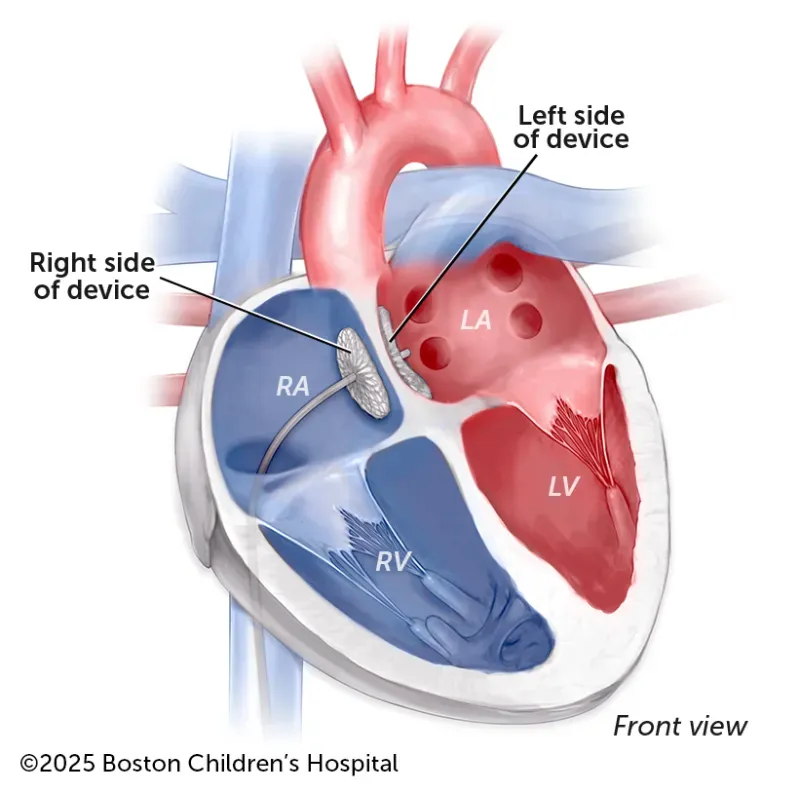
Cardiac catheterization can treat several heart conditions. It can insert a patch to close small holes caused by CHDs such as a ventricular septal defect or an atrial septal defect (shown here) or to block the overflow of blood in a vessel. It can also place a stent to open narrowed blood vessels.
A front view of an illustrated heart with an atrial septal defect shows how a cardiac catheterization procedure places a device in the middle of the heart wall to patch the hole between the left atrium and right atrium. The left side of the device stops the seepage of blood, allowing oxygen-rich blood to move directly from the left atrium to the left ventricle, which will pump out the blood to the body. The right side of the device keeps oxygen-poor blood in the right atrium, allowing a proper amount to be pumped to the lungs by the right ventricle.
A specially trained cardiologist performs cardiac catheterization. Some catheterizations are performed on an outpatient basis so the patient can go home on the same day as the procedure. Your cardiologist will tell you whether an outpatient procedure is appropriate and give details on how to prepare for a "heart cath."
First, we will give your child a sedative to help them relax and sleep during the procedure.
In the “cath lab,” your child will lie on a small table with a c-shaped X-ray machine. Heart monitors and other equipment are nearby. A specially trained staff of nurses, technicians, and physicians will monitor your child and make sure they are comfortable during the procedure.
We will withdraw the catheter and place several gauze pads on the site to prevent bleeding. If the blood vessels in the leg were used as the insertion site, your child will be told to keep their leg straight for a few hours after the procedure to minimize the chance of bleeding.
We will then take your child to a unit in the hospital to be monitored by nursing staff for several hours after the test. You will receive written instructions regarding care of the catheterization site, bathing, activity restrictions, and any new medications your child may need to take at home.
Depending on the results of the cardiac catheterization test, we may schedule additional tests or procedures to gather further diagnostic information.